
If you’re a Texas driver, you might wonder whether it’s legally acceptable—and safe—to rely on your vehicle’s adaptive cruise control (ACC) systems when driving in rain, snow, ice, or fog. Here’s what you need to know: while no Texas law explicitly bans ACC in bad weather, drivers must remain in control and respond to road conditions if a system fails or causes unsafe behavior.
Texas Law: Drivers Always in Control
Under Texas Transportation Code § 545.351 and § 545.353, drivers are required to adjust speed based on current conditions and always maintain control:
“An operator may not drive a vehicle at a speed greater than is reasonable and prudent under the conditions and having regard for actual and potential hazards”.
Additionally, variable speed limit laws allow authorities to reduce posted speeds in “wet or inclement weather,” reinforcing the expectation that drivers must use extra caution.
Implications for Using Adaptive Cruise Control
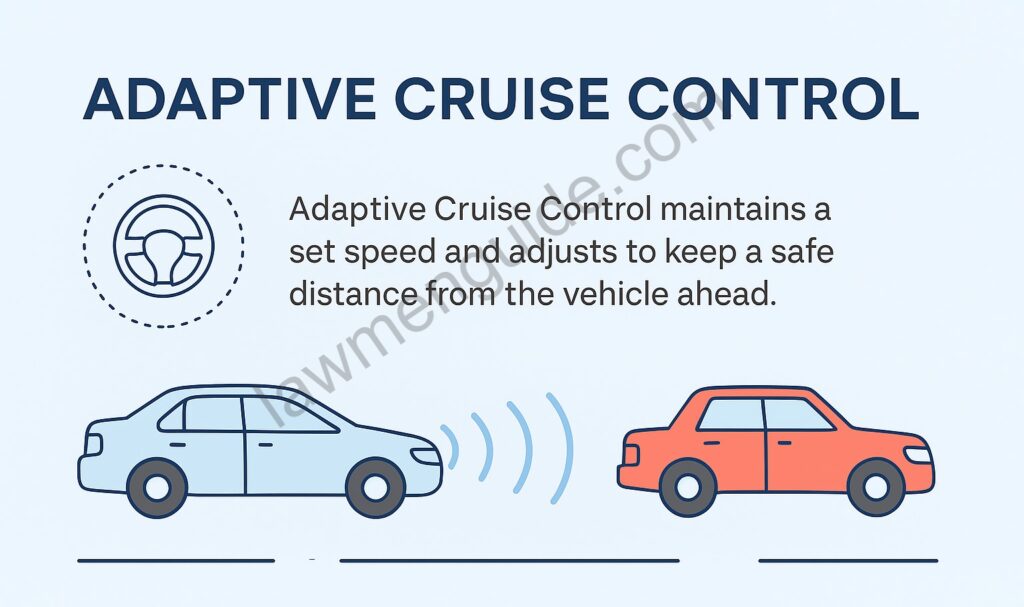
What Adaptive Cruise Control Does
ACC uses forward-facing sensors (radar or lidar) to maintain a set speed and following distance, automatically braking or accelerating to match traffic flow.
Why It’s Risky in Bad Weather
- Sensor failure: Rain, snow, fog, or dirt may block sensors, causing delayed or missed braking responses .
- Hydroplaning risk: Cruise control maintains throttle—when traction is lost, systems may delay reaction or worsen skidding risk.
- Delayed reaction: Automated throttle might be slower to adjust to sudden hazards like black ice.
Bottom line: ACC is not illegal in Texan bad weather, but law requires driver-initiated control and safe speed. ACC must never replace your judgment.
Liability: Who’s at Fault?
Using ACC under adverse weather comes with legal risks:
- Driver responsibility: If ACC failure or misuse contributes to a crash—e.g., hydroplaning—the driver may be deemed negligent under § 545.351’s “reasonable and prudent” speed requirement.
- Product liability: If ACC malfunctions due to faulty design, a driver may have grounds to sue the manufacturer—but only if the driver exercised proper caution.
Safe & Legal Use of ACC in Texas
| Weather Condition | ACC Legal? | Best Practice |
|---|---|---|
| Light rain | ✅ Yes, if driver stays alert | Reduce speed, increase following distance manually |
| Heavy rain/sleet | ⚠️ Use with caution—risk of hydroplaning | Avoid using ACC; maintain full manual control |
| Snow/ice/slush | ⚠️ Risk exceeds technology capability | Do NOT use ACC; manual driving only |
| Fog or low visibility | ⚠️ Sensors may fail to detect hazards | Keep speed low; avoid ACC |
Rules of thumb:
- Always monitor and override ACC when necessary.
- Manoeuver manually in slippery or low-visibility conditions.
- Treat ACC as a driver-assist, not a replacement for active driving.
Why Cruise Control in Bad Weather Matters
Legal Expectation
Texas law makes no exceptions for ACC: you must drive at a safe speed and maintain control.
Real-World Insurance & Crash Risk
Insurance experts caution against using cruise control in rain or ice, as it increases the risk of accidents and liability.
Quick Tips for Texas Drivers
- Turn off ACC in heavy rain, ice, slush, or fog.
- Always watch road conditions and be ready to take manual control.
- Lower your speed, especially when precipitation is present—even if your car’s sensors seem unaffected.
- Maintain greater following distances—double normal gap in rain and increase further in icy conditions.
- Keep sensors clear of mud, snow, or ice for optimal ACC performance.
- Review your owner’s manual for specific guidance on ACC in poor conditions.
Conclusion
In Texas, using adaptive cruise control during adverse weather is not illegal—but comes with serious conditions. You must drive at a reasonable, prudent speed, maintain control, and adapt to the conditions, as required by law. Failing to do so could result in negligence liability, even if ACC was enabled.
Bottom line: ACC is a helpful tool—but stay alert, know when to disengage it, and always drive with caution when the weather turns bad.
- Sierra Mist Lawsuit : What’s Actually True And What’s Internet Rumor
- Ashcroft Capital Lawsuit: Investor Concerns and Legal Challenges Explained

- Edward jones kingsview advisors lawsuit: Everything You Need to Know

- Denver Restaurant Service Charge Lawsuit: A Comprehensive Guide to Dining Fees and Worker Rights
- Texas Renaissance Festival Lawsuit: What the $60M Forced Sale Means
- Capitol Plaque Lawsuit: Why Officers Are Suing Even After Installation