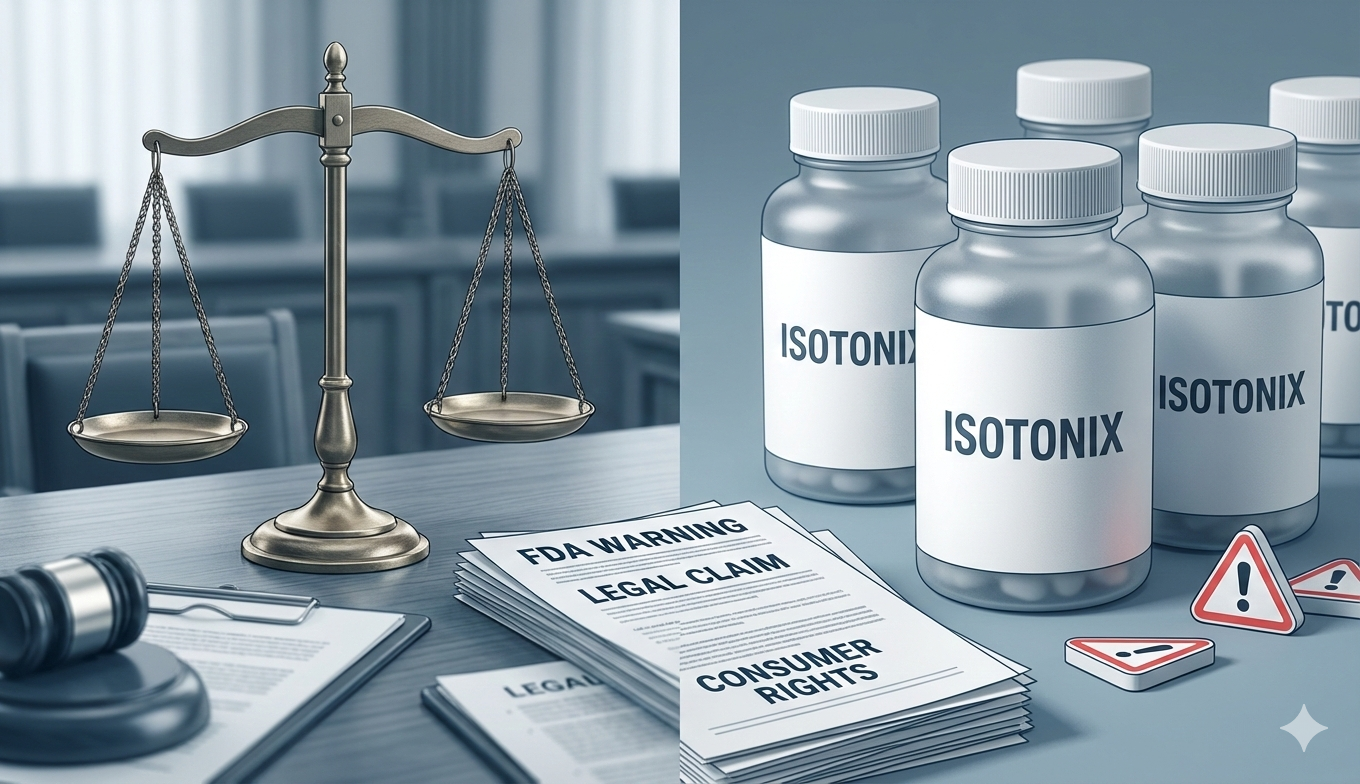
Isotonix is a popular line of dietary supplements marketed by Market America Inc., a North Carolina-based multi-level marketing (MLM) company. The supplements are known for their unique isotonic delivery system, which the company claims enhances nutrient absorption. However, over the past several years, Isotonix has become the subject of significant legal scrutiny, FDA warnings, and consumer complaints that have raised serious questions about the company’s business practices, product safety, and marketing claims.
While there is no single Isotonix lawsuit the brand has been at the center of multiple legal challenges involving Market America, including FDA enforcement actions, distributor pyramid scheme allegations, false advertising claims, and class action litigation. Understanding these various legal issues is crucial for consumers, potential distributors, and anyone considering using these products.
The FDA Warning Letter: What Government Regulators Found
The most significant and verified government action involving Isotonix came on February 12, 2020, when the U.S. Food and Drug Administration (FDA) issued an official warning letter to Market America Inc. This warning letter, documented in FDA records, identified serious regulatory violations related to multiple Isotonix products.
Specific Violations Cited by the FDA
The FDA warning letter cited that Isotonix OPC-3, Isotonix Multivitamin, and Isotonix Multivitamin with Iron product labels each include intervening material within the Supplement Facts label, which is not permitted. Information appearing on the information panel of the product label must appear in one place without other intervening material.
The Isotonix OPC-3 product was misbranded because the serving size declared on the label was incorrect, with directions of use suggesting consumers take 2 capfuls per 150 lbs of body weight, but the serving size listed only 1 capful.
The FDA found that Isotonix OPC-3 product failed to identify the part of the plant from which each botanical dietary ingredient is derived, as required by federal regulations.
Failure to Report Serious Adverse Events
A particularly concerning violation involved Market America’s failure to comply with adverse event reporting requirements. On February 12, 2020, the FDA sent a warning letter to Market America Inc for failure to submit serious adverse event reports about two of its products, as required by federal regulation.
Specifically, one complaint dated 1/28/2019 involved the TLS 21-Day Challenge Kit (which included Isotonix OPC-3), where a complainant reported inpatient hospitalization was needed due to various adverse reactions including abdominal pain, constipation, vomiting, dizziness, itching of skin, weakness, shaking, insomnia, chills, headache, tingling and numbness, and cramps after a week of using the products. Under federal law, Market America was required to submit a report of the serious adverse event no later than fifteen business days after the report was received.
Summary of FDA Violations Found
| Violation Type | Product(s) Affected | Regulatory Issue | Legal Implication |
| Label Format Violation | Isotonix OPC-3, Multivitamin, Multivitamin with Iron | Intervening material within Supplement Facts label (not permitted) | Violates FDA labeling requirements (21 CFR § 101.36) |
| Incorrect Serving Size | Isotonix OPC-3 | Directions suggested 2 capfuls per 150 lbs body weight, but label listed 1 capful as serving | Misbranding violation; consumer confusion risk |
| Incomplete Ingredient Disclosure | Isotonix OPC-3 | Failed to identify plant part source of botanical ingredients | Non-compliance with 21 CFR § 101.36(b)(1) |
| Adverse Event Non-Reporting | TLS 21-Day Challenge Kit (containing Isotonix OPC-3) | Failed to report serious adverse event (hospitalization) within 15 business days | Violation of DSHEA adverse event reporting requirements |
Deceptive Marketing and False Advertising Claims
Beyond the FDA violations, Isotonix has faced allegations regarding deceptive marketing practices. Market America’s core marketing claim centers on Isotonix products’ superior bioavailability the company asserts that the isotonic delivery system allows for faster and more efficient nutrient absorption than traditional pill or capsule forms.
However, multiple sources indicate that plaintiffs challenging these claims argue they lack adequate scientific support. Consumers and legal advocates have raised questions about whether the company possesses sufficient head-to-head human clinical trials comparing Isotonix absorption to traditional supplement forms, and whether marketing statements were exaggerated beyond what scientific evidence supports.
These claims have attracted scrutiny not only from consumers but also from consumer advocacy organizations focused on truth in advertising and from legal analysts specializing in consumer protection law.
Pyramid Scheme Allegations and MLM Structure Scrutiny
Market America’s multi-level marketing structure has faced significant legal challenges. In 2017, distributors named Chuanjie Yang and Ollie Lan filed a federal lawsuit originally in California, claiming Market America operated a pyramid scheme, with their argument being that most distributors lose money and the real focus is on recruitment over product sales. They claimed more than 90% of distributors ended up losing money.
The court agreed and officially stayed (paused) the case in 2018 to send it to arbitration instead of keeping it in court, meaning everything now happens behind closed doors.
In 2017, Truth in Advertising (TINA.org) investigated Market America for deceptive income claims, alleging that the company made misleading income representations to potential distributors, suggesting substantial earnings with minimal effort claims that would violate Federal Trade Commission (FTC) guidelines regarding MLM income disclosures.
Current Legal Status and Class Action Developments
The legal landscape surrounding Isotonix remains complex. While no single class action lawsuit is officially titled “Isotonix lawsuit” in federal court databases, multiple legal actions and proposed class actions have been filed raising product liability, false advertising, and consumer protection claims against Market America.
Some sources suggest that as of 2025, class action litigation remains in pre-trial phases, with discovery ongoing and both sides exchanging evidence. Market America has denied wrongdoing and continues to assert the legitimacy of its MLM business model and the safety of its products.
Timeline of Isotonix Legal Actions and Regulatory Events
| Date | Event | Details | Source |
| January 28, 2019 | Adverse Event Report | Hospitalization complaint filed involving TLS 21-Day Challenge Kit (containing Isotonix OPC-3) with serious symptoms including abdominal pain, vomiting, dizziness, weakness | FDA Records |
| February 12, 2020 | FDA Warning Letter Issued | Market America cited for labeling violations, incorrect serving sizes, failure to identify plant parts, and failure to report serious adverse events | U.S. Food and Drug Administration (Official) |
| 2017 | Pyramid Scheme Lawsuit Filed | Chuanjie Yang and Ollie Lan filed federal lawsuit alleging Market America operated as pyramid scheme with 90%+ distributor loss rate | U.S. Federal Court (California) |
| 2017 | TINA Investigation | Truth in Advertising (TINA.org) investigated deceptive income claims to distributors | Truth in Advertising (Consumer Advocacy) |
| 2018 | Case Sent to Arbitration | Federal court agreed to Yang lawsuit claims and stayed (paused) case, requiring arbitration instead | Federal Court Order |
| 2020-2025 | Ongoing Class Actions | Multiple class action lawsuits in pre-trial/discovery phases alleging false advertising, product liability, consumer protection violations | Federal Courts |
Regulatory and Industry Implications
The FDA warning letter and surrounding legal challenges have significant implications for both the company and the broader dietary supplement industry. The controversies have led to skepticism regarding the safety, efficacy, and marketing practices of Isotonix products. Consumer trust concerns are raised, and consumers are urged to exercise due diligence and consult healthcare professionals before using such supplements.
As the supplement industry continues to grow, the lessons from the Isotonix lawsuit will likely influence future business practices and regulatory policies. Companies must ensure that their products are marketed truthfully, with claims supported by scientific evidence, and that all labeling meets legal standards.
The situation highlights the necessity for stringent regulatory measures to ensure that dietary supplements are safe, accurately labeled, and marketed honestly. For regulatory context, you may want to consult a experienced legal guidance if you believe you’ve been harmed by a supplement product.
What Consumers Should Know
If you have used Isotonix products or are considering using them, it’s important to understand your rights and take protective measures:
Document Everything: Keep product bottles, receipts, medical records, and symptom journals if you experience adverse reactions.
Report to FDA: You can file a report with the FDA’s MedWatch program if you experience unexpected adverse reactions to dietary supplements.
Consult Healthcare Providers: Before using any dietary supplement, especially those marketed with broad health claims, consult with qualified healthcare professionals about potential risks and interactions.
Verify Claims: Be skeptical of supplement claims that sound like drug claims. Under FDA law, dietary supplements cannot claim to diagnose, cure, prevent, or treat diseases.
Review Independent Testing: Organizations like Consumer Lab and Lab door offer independent lab testing and ratings for supplements, which can provide verification of product quality and ingredient accuracy.
If you believe you’ve been harmed by Isotonix or other dietary supplements and want to understand your legal options, consulting with an attorney experienced in consumer protection and product liability cases is advisable. You may also want to explore options for legal representation if you’ve suffered injuries.
Types of Legal Claims Against Market America/Isotonix
| Claim Type | Description | Status | Potential Relief |
| False Advertising | Marketing claims about bioavailability lack sufficient scientific evidence; exaggerated health benefits | Active (Class Action) | Monetary damages, injunctive relief |
| Product Liability | Products caused injury or harm; inadequate warnings; defective design | Active (Multiple Cases) | Compensatory damages, medical expense recovery |
| Pyramid Scheme | Emphasis on recruitment over product sales; 90%+ of distributors lose money | Arbitration (since 2018) | Restitution, treble damages under FTC Act |
| Consumer Protection Violations | Deceptive marketing; misrepresentation of income potential; false health claims | Active (Multiple States) | Statutory damages, attorney fees |
| FDA Labeling Violations | Non-compliant labeling; incorrect information; missing disclosures | Verified (Feb 2020) | Warning letter, potential enforcement action, product seizure |
| Breach of Contract | Distributors claiming unfulfilled promises about earning potential | Arbitration (Various) | Restitution, contract damages |
The Importance of Transparency in the Supplement Industry
The Isotonix case serves as an important reminder that dietary supplements, while not as heavily regulated as pharmaceuticals, are still subject to FDA oversight and must comply with labeling and advertising requirements. By choosing reputable brands, verifying product claims, and consulting healthcare professionals, consumers can protect themselves from potentially misleading products.
Market America has denied allegations of wrongdoing and maintains that Isotonix products are safe and beneficial. However, the company’s continued legal challenges and regulatory scrutiny underscore the importance of consumer vigilance when purchasing dietary supplements.
Conclusion
The Isotonix lawsuit or more accurately, the constellation of legal challenges involving Market America and Isotonix represents a significant case study in dietary supplement regulation, MLM business practices, and consumer protection. The FDA’s 2020 warning letter documenting labeling violations and failure to report adverse events remains the most concrete regulatory action verified in government records.
Whether you are a current user, potential distributor, or prospective consumer, understanding the legal and regulatory landscape surrounding Isotonix is essential. Stay informed about developments, consult healthcare providers, document any adverse reactions, and exercise due diligence when evaluating supplement products and business opportunities.
As of 2025, various legal proceedings continue, and the ultimate outcomes may have significant implications for both Market America and the broader dietary supplement industry regarding transparency, compliance, and consumer safety.|