
Car accidents are stressful, both physically and emotionally. But when you believe the accident was partly your fault, things can get even more complicated. If you’re asking, “Can I file a claim if the car accident was partly my fault?” — the answer is: Yes, but it depends on your state laws and the specifics of your case.
This article provides a comprehensive look at how fault impacts your ability to file an insurance claim or personal injury lawsuit in the United States, especially under the laws of comparative negligence, contributory negligence, and no-fault systems.
Understanding Fault in Car Accidents
When a car accident occurs, insurance companies and legal authorities will assign fault based on evidence such as:
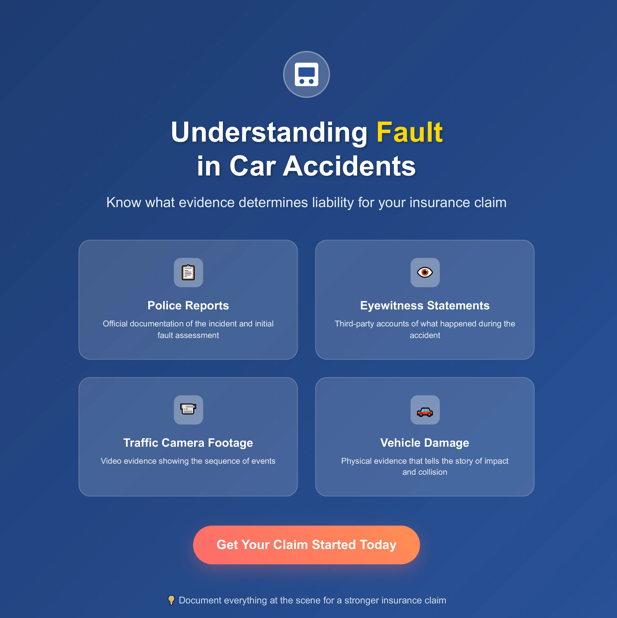
- Police reports
- Eyewitness statements
- Traffic camera footage
- Vehicle damage
In Texas, fault determination in a car accident claim depends on several key factors. Investigators will assess whether any traffic laws were violated such as speeding or illegal lane changes—as well as signs of distracted or impaired driving. Understanding these elements is essential when filing a claim, especially under Texas’s comparative fault rules.
Determining who is responsible is crucial because it affects who pays and how much.
Comparative vs. Contributory Negligence: State Laws Matter
Every state has its own legal doctrine that determines how fault impacts a victim’s right to compensation.
Fault Rules by State
| Negligence Rule | Description | States That Use It |
|---|---|---|
| Pure Comparative | You can recover damages even if you’re 99% at fault | California, New York, Florida, etc. |
| Modified Comparative | You can recover only if you’re less than 50% or 51% at fault | Texas, Illinois, Colorado, etc. |
| Contributory Negligence | You get nothing if you’re even 1% at fault | Alabama, Maryland, North Carolina, Virginia, DC |
| No-Fault System | You claim compensation from your own insurer, regardless of fault | Florida, Michigan, New Jersey, etc. |
Fault System by State (U.S.)
| State | Fault Rule | Can You File If Partly At Fault? |
|---|---|---|
| California | Pure Comparative Negligence | Yes, even if 99% at fault |
| Florida | Modified Comparative | Yes, if 50% or less at fault |
| Texas | Modified Comparative | Yes, if less than 51% at fault |
| New York | Pure Comparative Negligence | Yes, even if mostly at fault |
| North Carolina | Contributory Negligence | No, not even if 1% at fault |
| Virginia | Contributory Negligence | No, not even if 1% at fault |
| Illinois | Modified Comparative | Yes, if less than 51% at fault |
| Georgia | Modified Comparative | Yes, if less than 50% at fault |
Can You File a Claim If You Were Partly at Fault?
Yes, you can — but your recovery may be reduced. Here’s how:
1. Filing with Your Own Insurance
In no-fault states, your Personal Injury Protection (PIP) will cover your medical expenses up to a limit — regardless of fault. You usually can’t sue unless you meet a threshold for serious injury. A personal injury lawyer can help you recover compensation even if you were partly at fault in the car accident.
2. Filing with the At-Fault Driver’s Insurance
If your state allows it, you can file a third-party claim. Your compensation will be reduced by your percentage of fault.
Example: If your damages are $50,000 and you’re 30% at fault, you may only receive $35,000.
3. Filing a Personal Injury Lawsuit
In comparative fault states, you can sue the other party, but the court will reduce your award based on fault. In contributory negligence states, this is often not possible unless you’re found 0% at fault.
Factors That Affect Shared Fault Determination
Several things influence how much fault you’re assigned:
- Was the other driver speeding?
- Were you distracted while driving?
- Was a traffic law violated?
- Were road conditions poor?
- Did both drivers contribute to the crash?
Impact of Shared Fault on Compensation (Hypothetical Example)
% of Fault | Compensation on $100,000 Claim
-----------|-------------------------------
0%         | $100,000
10%        | $90,000
25%        | $75,000
50%        | $50,000
75%        | $25,000
99%        | $1,000
100%       | $0
Steps to Take If You’re Partly at Fault
If you’re partly at fault in a car accident in Texas, avoid admitting guilt and let authorities determine liability. File a police report, gather evidence, seek medical care, and notify your insurer. As per IRS guidelines, personal injury settlements for physical injuries are generally non-taxable, but consult a tax professional for clarity on your case.
- Don’t admit fault at the scene – Let investigators do their job.
- Call the police and file a report.
- Gather evidence – photos, witnesses, dashcam footage.
- Seek medical attention – even if injuries seem minor.
- Contact a car accident attorney for guidance.
- Notify your insurance company immediately.
FAQs
Can I still sue if I was partially at fault?
Yes, if your state allows comparative negligence. Your award will be reduced by your share of fault.
What if the other driver denies fault?
Your attorney can help gather evidence and build a strong case to show the other party’s liability.
Can both drivers be 50% at fault?
Yes. In some accidents, fault is equally shared. In such cases, each party is responsible for their own damages unless the state uses a 51% bar rule.
Will my insurance premiums go up?
Possibly. If you’re found partially at fault, insurers may increase your premiums upon renewal.
Final Thoughts
Being partially at fault in a car accident doesn’t necessarily mean you lose your right to compensation. Most U.S. states follow some form of comparative negligence, which allows you to file a claim and recover damages — albeit reduced.
Always consult with a qualified personal injury lawyer to understand how your state laws apply to your situation. An experienced attorney can protect your rights, negotiate with insurers, and help maximize your compensation.
- Sierra Mist Lawsuit : What’s Actually True And What’s Internet Rumor
- Ashcroft Capital Lawsuit: Investor Concerns and Legal Challenges Explained

- Edward jones kingsview advisors lawsuit: Everything You Need to Know

- Denver Restaurant Service Charge Lawsuit: A Comprehensive Guide to Dining Fees and Worker Rights

- Texas Renaissance Festival Lawsuit: What the $60M Forced Sale Means

- Capitol Plaque Lawsuit: Why Officers Are Suing Even After Installation