
Texas may be known for its wide-open highways and oversized trucks, but for many residents, mopeds offer an affordable, fuel-efficient way to get around. Whether you’re a college student in Austin or a commuter in Houston, knowing the latest moped laws in Texas can help you stay compliant and safe.
This 2025 guide breaks down everything you need to know about riding a moped legally in Texas — from license requirements and insurance to where you can ride and what counts as a moped.
What Is a Moped Under Texas Law?
According to the Texas Transportation Code, a moped is defined as:
- A two-wheeled or three-wheeled vehicle
- Engine displacement not exceeding 50cc
- Cannot exceed 30 mph on level ground
- Does not require gear shifting by the rider
If your vehicle exceeds any of the above specs — especially speed or engine size — it is legally considered a motorcycle, not a moped, and different laws apply.
Texas Moped License Requirements
Yes, you need a license to ride a moped in Texas. As of 2025, these are your options:
| License Type | Requirement |
| Class M License | Full motorcycle license with a moped restriction |
| Class M (moped-only) | Available for riders aged 15+ with written test (no skills test) |
| Instruction Permit | Available at age 15 with guardian approval (for learning purposes) |
You do not need to complete a full motorcycle safety course if you’re only applying for a moped license.
Do You Need to Register a Moped in Texas?
Yes. As of 2025, moped registration is mandatory with the Texas Department of Motor Vehicles (TxDMV).
| Registration Requirement | Details |
| Title Required | Yes |
| License Plate | Yes (specific moped plate issued) |
| Vehicle Inspection | Not required for mopeds |
| Proof of Insurance | Yes – Minimum liability coverage |
Even though mopeds have smaller engines, they must be registered, insured, and display a valid license plate.
Do You Need a License to Drive a Moped Under 50cc in Texas?
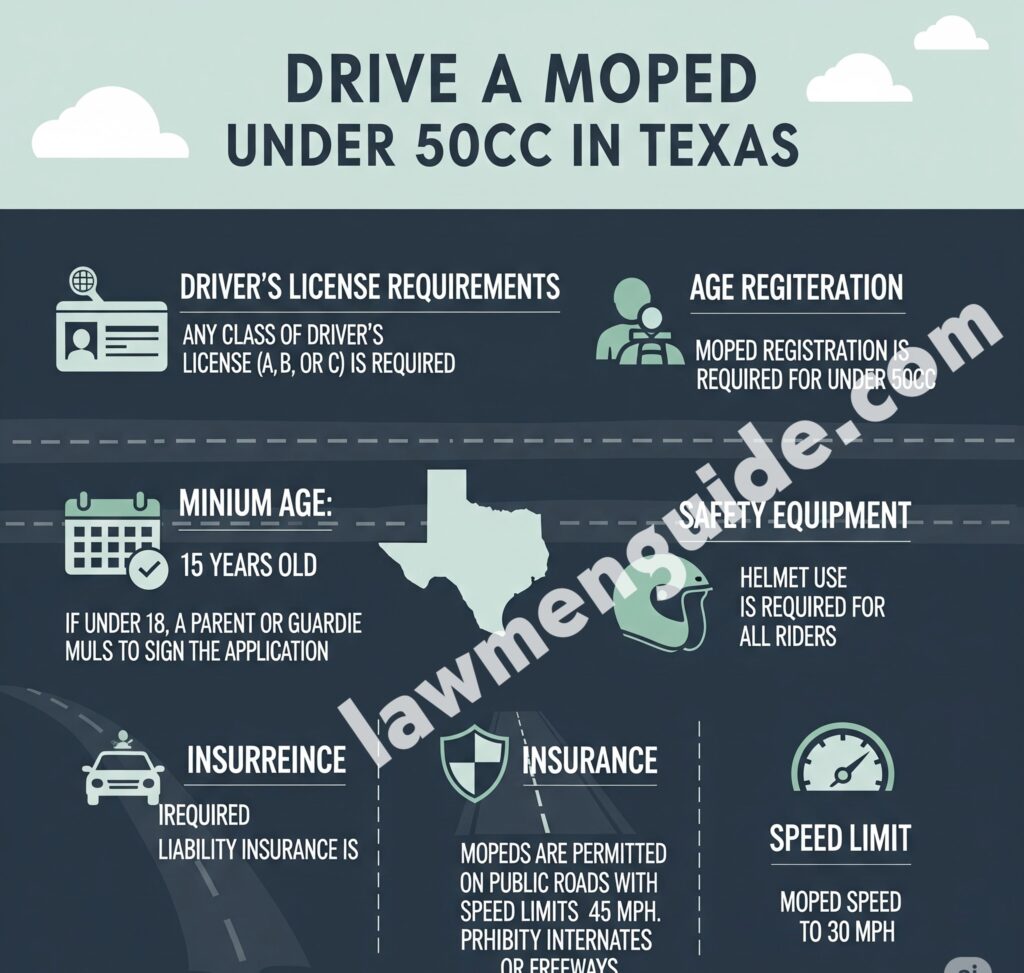
Yes, you absolutely do. Even if your moped is under 50cc and doesn’t exceed 30 mph, Texas law requires a valid driver’s license to operate it on public roads.
If you’re at least 15 years old, you can apply for a Class M license with a moped restriction. This involves passing a written knowledge test — no road skills test is needed for mopeds.
The following options are available:
- Already have a Texas driver’s license? You can add a moped endorsement without needing an entirely new license.
- No driver’s license yet? Apply for a moped-only license at 15+ with parent/guardian consent.
There’s a misconception that mopeds are exempt from licensing due to their size — but under Section 521.224 of the Texas Transportation Code, a license is always required to operate any motorized vehicle on a public roadway, regardless of engine size.
Where Can You Ride a Moped in Texas?
Mopeds are allowed on most public roads, but there are a few key restrictions:
- Not permitted on highways with speed limits over 45 mph unless the moped can maintain the minimum posted speed.
- Not allowed on sidewalks, hike-and-bike trails, or pedestrian walkways.
- Must ride in the right-hand lane or bike lane when available.
- Riders must obey all standard traffic laws, signals, and signage.
Safety Gear and Helmet Laws
In Texas, helmets are recommended but not required by law for moped riders 18 years or older. Riders under 21 must wear an approved helmet.
| Age | Helmet Required? |
| Under 21 | Yes |
| 21+ | No (but strongly recommended) |
Reflective clothing and protective gloves are also encouraged for visibility and safety.
Insurance Requirements for Mopeds in Texas
All mopeds must carry minimum liability insurance, just like cars and motorcycles.
| Coverage Type | Minimum Amount (2025) |
| Bodily Injury (per person) | $30,000 |
| Bodily Injury (per accident) | $60,000 |
| Property Damage | $25,000 |
Failure to carry insurance can result in fines, license suspension, and registration cancellation.
Moped vs. Scooter vs. Motorcycle in Texas
Understanding the difference matters — the wrong classification could lead to fines or impounding.
| Vehicle Type | Engine Size | Top Speed | License Needed | Registration |
| Moped | ≤ 50cc | ≤ 30 mph | Class M or Moped-only | Yes |
| Scooter | 51cc–249cc | 30–60+ mph | Class M | Yes |
| Motorcycle | 250cc+ | 60+ mph | Class M | Yes |
Always check your owner’s manual or manufacturer label to confirm your engine specs.
Smart Tips for Moped Riders in Texas
- Use turn signals or hand signals at all times
- Avoid riding during heavy rain or night without reflective gear
- Make eye contact with other drivers at intersections
- Carry a printed copy of your registration and insurance
- Join a local moped rider group for safety and maintenance support
FAQs About Texas Moped Laws
Q1: Can I ride a moped in Texas without a driver’s license?
No. A valid driver’s license with a Class M or moped restriction is mandatory.
Q2: Are electric mopeds treated the same as gas mopeds?
Yes, as long as they meet the definition of a moped (≤ 50cc equivalent, ≤ 30 mph). Otherwise, they may be considered electric bicycles or scooters.
Q3: Can I ride a moped on the shoulder of the road?
Only when avoiding an obstacle or when legally permitted. In general, mopeds must ride in the designated traffic lane
Q4: Do I need a special permit for a passenger?
Mopeds are generally designed for single riders. If your moped has a second seat and footrests, a passenger may be allowed — but this varies by manufacturer and local regulation.
Final Thoughts
Mopeds are a practical and fun way to get around Texas cities, but they come with legal responsibilities. From licensing and registration to insurance and road rules, staying informed keeps you safe and legal.
Texas may offer a more relaxed lifestyle, but when it comes to traffic law, it doesn’t play around. Whether you’re a new rider or thinking of switching from a car to a moped for your commute, take the time to understand the law — and enjoy the ride safely.
- Sierra Mist Lawsuit : What’s Actually True And What’s Internet Rumor
- Ashcroft Capital Lawsuit: Investor Concerns and Legal Challenges Explained

- Edward jones kingsview advisors lawsuit: Everything You Need to Know

- Denver Restaurant Service Charge Lawsuit: A Comprehensive Guide to Dining Fees and Worker Rights

- Texas Renaissance Festival Lawsuit: What the $60M Forced Sale Means

- Capitol Plaque Lawsuit: Why Officers Are Suing Even After Installation