
Texas is known for its big highways, bigger trucks, and clear-cut traffic laws. One law that often causes confusion among drivers, especially those moving from other states, is the requirement for front license plates. Do you really need one? What if your car wasn’t designed to hold a front plate?
In this article, we break down the Texas front license plate requirements for 2025, explore exceptions, penalties, mounting tips, and provide actionable information that every Texas driver—resident or newcomer—should know.
What Does Texas Law Say About Front License Plates?
Texas law requires most vehicles to display both a front and rear license plate. This rule is part of the Texas Transportation Code § 504.943, which mandates:
“A person commits an offense if the person operates on a public highway during a registration period a passenger car or commercial motor vehicle that does not display two license plates, at the front and rear of the vehicle.”
In Texas, most vehicles must display two license plates—front and rear. Exceptions apply to motorcycles, trailers, and semi-trailers. Driving without a front plate can lead to fines up to $200, though some courts allow dismissal if the plate is quickly installed with a small fee. Plates must be securely mounted on the outside of the vehicle, not on the dashboard or windshield.
Vehicles Affected
| Vehicle Type | Front Plate Required? |
|---|---|
| Passenger Vehicles | Yes |
| Commercial Vehicles | Yes |
| Classic Cars (with antique tags) | No |
| Motorcycles | No |
| Trailers | Rear plate only |
| Sports cars without bracket | Generally Yes (See exceptions) |
Important: The requirement applies regardless of whether your vehicle has a front plate bracket—if your vehicle is registered in Texas, you are generally required to display both plates.
Why Does Texas Require a Front Plate?
While many argue it affects aesthetics—especially on luxury and sports cars—Texas DMV and law enforcement point to practical advantages, such as:
- Easier vehicle identification from the front by law enforcement
- More effective toll enforcement (camera-based)
- Better traffic surveillance and parking control
- Assistance in Amber Alerts and stolen vehicle tracking
Are There Any Exceptions to the Front Plate Requirement?
Yes. Texas does allow a narrow exception for vehicles that were not originally manufactured to be equipped with a front license plate bracket.
Conditions for Exception
- The vehicle must be a passenger car.
- It must be not manufactured with a front plate mount or bracket.
- The vehicle must have been first registered in Texas before September 1, 2019, under HB 1755.
- You must carry documentation to support the exception if pulled over.
However, new models after 2019 are no longer eligible under this clause—even if the manufacturer does not include a bracket.
What Are the Penalties for Not Displaying a Front Plate?
Legal Penalty
- Violation Type: Misdemeanor (Class C)
- Fine: Up to $200
Practical Risks
- You can be stopped by police for this offense alone.
- May impact insurance in case of a collision (non-compliance).
- Risk of being ticketed in toll zones that require dual plate reading.
How to Properly Mount a Front License Plate
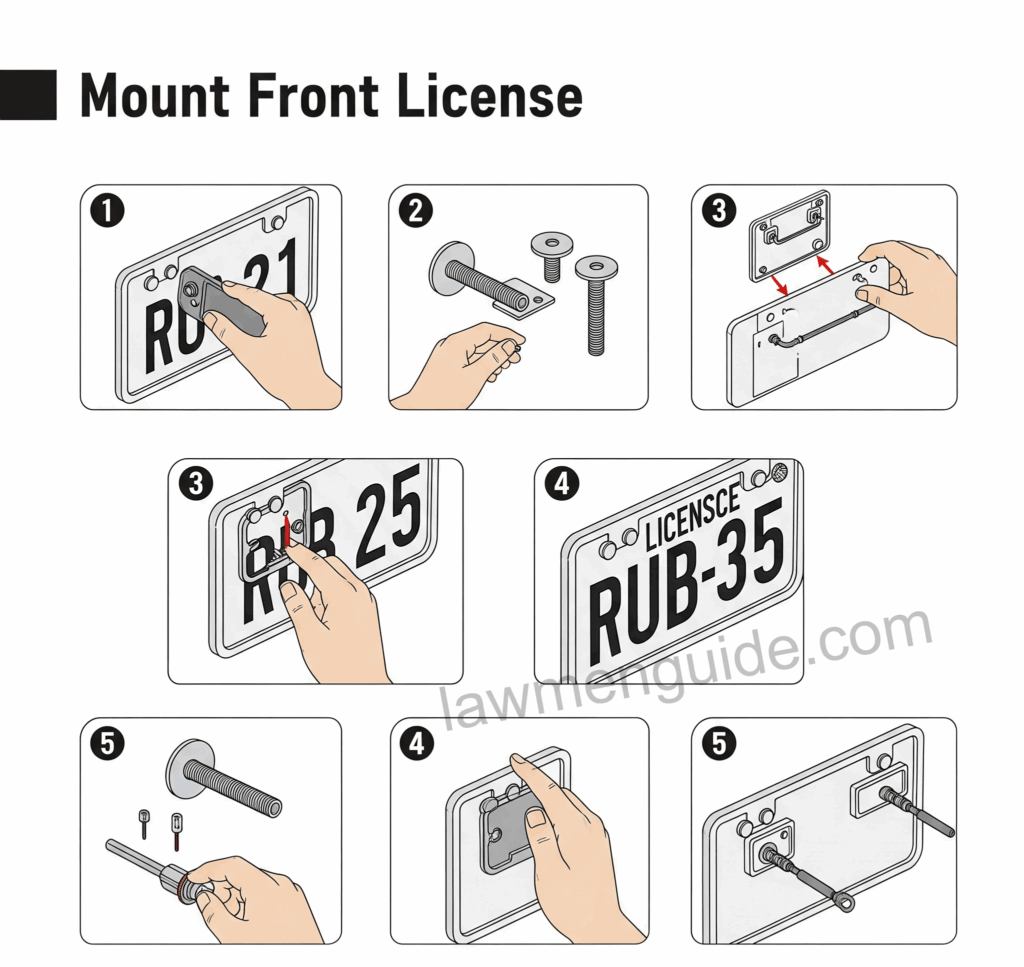
Even if your car lacks a built-in bracket, there are several ways to comply:
Mounting Options
| Option | Description | Cost Estimate |
|---|---|---|
| OEM Bracket Kit | From car manufacturer (may need drilling) | $20–$70 |
| No-Drill Bracket | Clips or mounts onto grille without damage | $30–$80 |
| Tow Hook Mount | Attaches to tow hook area on front bumper | $25–$100 |
| Magnetic Mount | Uses strong magnets—check legality in your area | $40–$90 |
| Adhesive Plate Holder | Tape-based or suction-based – less secure | $15–$50 |
Tip: Always check the compatibility of the mounting method with your car’s make/model before purchasing.
Do Out-of-State Drivers Need a Front Plate in Texas?
If you’re visiting Texas temporarily in a vehicle registered in a state that does not require a front plate, you’re exempt.
However, if you move and register your vehicle in Texas, you must follow Texas law, regardless of where your car was previously registered.
Recent Changes and Updates in 2024–2025
- HB 1755 (2019) previously offered limited exemptions, but no new exemptions have been added as of 2025.
- Digital license plate pilot programs are under discussion but have not yet altered the requirement for front plates.
- Increased enforcement is observed in urban areas (e.g., Austin, Dallas, Houston).
Stay up to date by visiting the official Texas DMV website.
Common FAQs
Q1. What if my car didn’t come with a front bracket?
You’re still required to install one. Texas law doesn’t exempt vehicles without mounting points unless they were registered before Sept 2019 under specific conditions.
Q2. Can I use a dashboard-mounted plate instead?
No. The plate must be permanently mounted to the front of the vehicle in a horizontal position, at least 12 inches above the ground.
Q3. What if my front plate falls off?
You may be pulled over and fined. Replace or reattach the plate as soon as possible.
Q4. Can I request a single plate exemption for aesthetic reasons?
No. Personal or aesthetic preferences do not qualify for legal exemption under current Texas laws.
Q5. Will this law change anytime soon?
No updates are scheduled as of 2025, but it remains a topic of debate. Watch Texas legislature updates for any future amendments.
Texas Front License Plate Law
| Key Requirement | Details |
|---|---|
| Number of Plates Required | 2 (front and back) |
| Governing Law | Texas Transportation Code § 504.943 |
| Exceptions | Rare—older models before Sept 2019 |
| Penalty | Up to $200 fine |
| Mounting Methods Available | Drill, no-drill, tow hook, adhesive |
| Tourist Exemption | Yes, if car is registered out-of-state |
Final Thoughts
If you’re driving in Texas, displaying a front license plate isn’t optional—it’s the law. Even if your vehicle was designed for aesthetic purposes or lacks a bracket, you’re expected to make it work using compliant mounting options. While the law has sparked debates among car enthusiasts, enforcement is real, and the consequences can add up.
📌 Pro Tip: Invest in a stylish no-drill or tow-hook mount to stay legal without compromising your vehicle’s look.
- Sierra Mist Lawsuit : What’s Actually True And What’s Internet Rumor

- Ashcroft Capital Lawsuit: Investor Concerns and Legal Challenges Explained

- Edward jones kingsview advisors lawsuit: Everything You Need to Know

- Denver Restaurant Service Charge Lawsuit: A Comprehensive Guide to Dining Fees and Worker Rights

- Texas Renaissance Festival Lawsuit: What the $60M Forced Sale Means

- Capitol Plaque Lawsuit: Why Officers Are Suing Even After Installation