
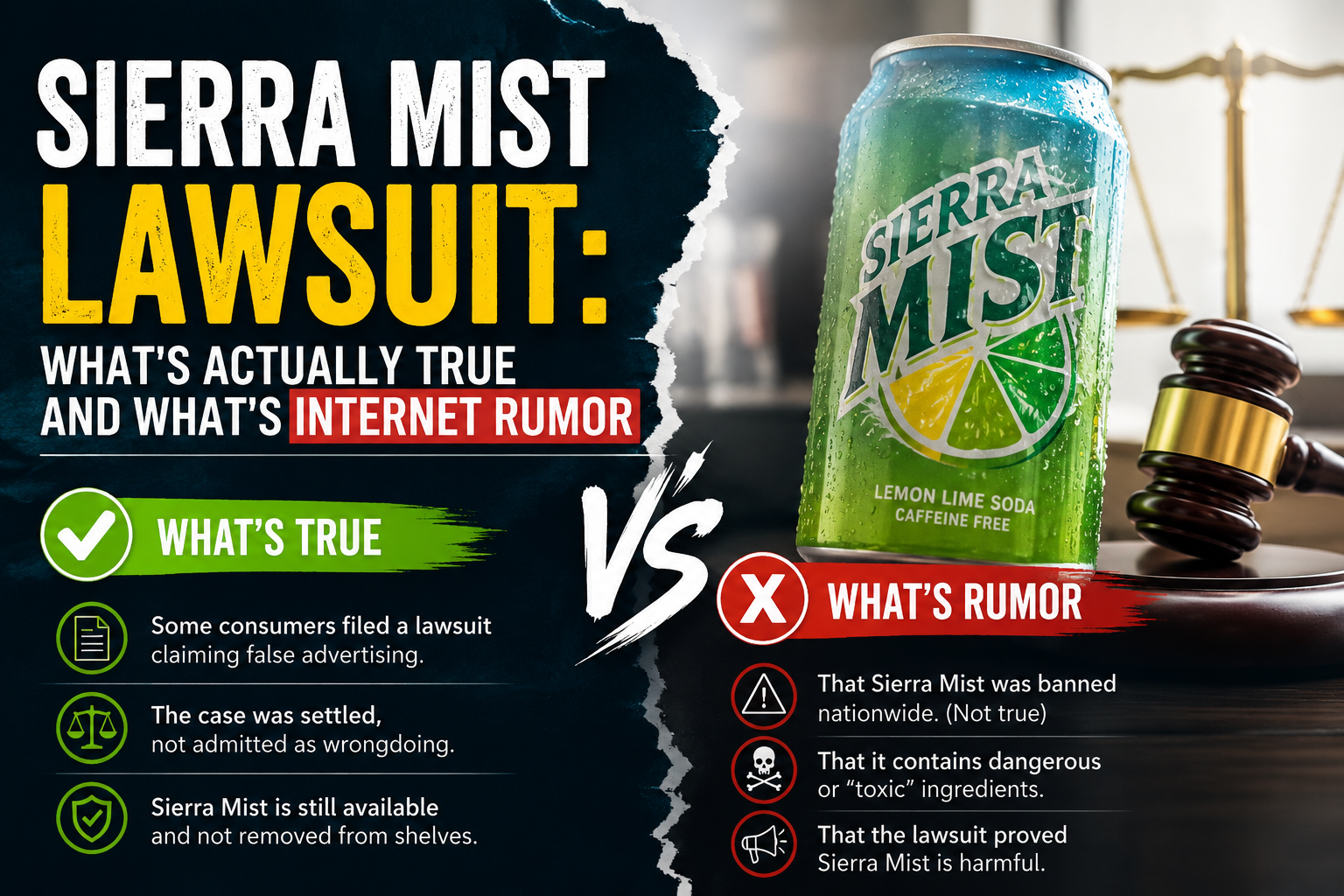
If you searched Sierra Mist lawsuit and landed here, you’re probably trying to figure out whether PepsiCo, its discontinued lemon-lime soda, or a viral TikTok creator with a similar name was actually involved in a real court case. It’s a fair question the term shows up constantly in search results, social posts, and even AI-generated law blog articles. This guide separates verified fact from recycled internet myth, and explains exactly where the confusion started.
The Short Answer
There is no verified, publicly filed lawsuit called the Sierra Mist lawsuit No court record, case number, docket entry, or legitimate news outlet has confirmed litigation matching the descriptions circulating online. What actually happened is far less dramatic: PepsiCo discontinued the Sierra Mist brand in early 2023 and replaced it with a new lemon-lime soda called Starry. Everything else claims of trademark battles, TikTok lawsuits, or secret settlements traces back to speculation, rumor, and low-quality content that has been repeated so often it now reads as established fact.
What Actually Happened to Sierra Mist
PepsiCo launched Sierra Mist in 1999 as a direct challenger to Sprite and 7UP, positioning it as a caffeine-free, lemon-lime soda with a “natural” and refreshing image. Despite loyal fans, the brand never captured significant market share against Sprite’s dominance. PepsiCo tried a few rebrand attempts over the years, including a short-lived Mist Twist name change between 2016 and 2018, but none of these efforts meaningfully shifted its position in the soda market.
By the early 2020s, Sierra Mist reportedly held less than one percent of the carbonated soft drink market. Rather than continue investing in a struggling brand, PepsiCo made a straightforward business decision: retire Sierra Mist and launch an entirely new lemon-lime product, Starry, in January 2023, backed by a fresh marketing campaign aimed squarely at competing with Sprite.
This kind of brand discontinuation and replacement is common in the beverage industry and does not, by itself, involve any lawsuit. Companies retire underperforming products and launch new ones under new names on a regular basis.
Where the “Lawsuit” Rumor Came From
Two separate storylines appear to have merged into the Sierra Mist lawsuit search trend that exists today.
1. Consumer Confusion Over the Starry Rebrand
When Sierra Mist fans discovered their favorite soda had quietly disappeared and been replaced by Starry, many felt misled, assuming Starry was simply a renamed version of the same product rather than a distinct reformulation. That frustration spread across social media and forums, with some posts framing the situation as if PepsiCo had done something legally questionable by tricking customers. However, no attorney, law firm, or regulatory body has filed or announced an actual consumer protection or false advertising case over the switch. The closest thing to documentation is speculative commentary from small blogs suggesting a lawsuit could happen not that one has.
2. The Cierra Mist lawsuit TikTok Myth
A second, unrelated storyline involves a TikTok creator whose name is spelled similarly to the soda brand. According to widely circulated posts, this creator was supposedly sued by PepsiCo for trademark infringement, and the resulting legal battle was framed as the real reason Sierra Mist was discontinued and rebranded as Starry. Some versions of the story claim the creator won a settlement; others claim PepsiCo sent a cease-and-desist letter.
This version of events has no supporting documentation. There is no court filing, no statement from PepsiCo, and no confirmation from the creator herself establishing that this lawsuit exists. Fact-checking coverage of the claim has specifically noted that no record of such a case can be found anywhere. The timeline also doesn’t hold up: PepsiCo’s decision to retire Sierra Mist was tied to years of weak sales performance against Sprite, not a sudden trademark dispute with an individual social media user.
In short, the Cierra Mist lawsuit appears to be an internet legend that gained traction because it made an otherwise mundane corporate branding decision sound like a viral drama which naturally spreads faster online than the real, less exciting explanation.
Why So Many Articles Describe It as a Real Case
If you search this topic, you’ll likely encounter several articles that describe a detailed Sierra Mist trademark lawsuit complete with legal terminology like likelihood of confusion dilution and case outcomes. It’s important to read these critically. Several of these pages do not cite an actual court, plaintiff, defendant, judge, filing date, or case number the basic elements any real lawsuit summary would include. Many appear to be generated primarily to attract search traffic around a trending phrase rather than to report verified legal events.
A genuine legal case, even a minor one, leaves a documented trail: a docket number in a state or federal court system, a named plaintiff and defendant, and typically at least one credible news outlet reporting on the filing. The absence of any of that here is itself a strong signal that no such lawsuit exists.
A Quick Primer on Trademark Law (For Context)
Even though this specific case isn’t real, it’s useful to understand what an actual trademark dispute like this would involve, since the topic keeps coming up in searches.
- Likelihood of confusion: Courts assess whether an average consumer could mistake one brand, name, or product for another based on similarities in name, logo, packaging, or industry.
- Strength of the mark: Distinctive, well-known trademarks receive broader legal protection than generic or descriptive names.
- Prior use: Trademark rights in the U.S. generally favor whoever used a name in commerce first, within a relevant market or geography.
- Dilution: Owners of famous trademarks can sometimes object to unrelated uses of a similar name if it weakens the distinctiveness of their brand, even without direct consumer confusion.
These are the kinds of legal questions a real Sierra Mist trademark case would raise but again, no such case has actually been filed or decided.
What This Means for Consumers
If you’re trying to figure out whether you have any legal standing or claim related to Sierra Mist’s discontinuation, the honest answer is: almost certainly not. Discontinuing a product and launching a new one under a different name and formula is a standard business decision, not a deceptive practice, unless a company makes specific false claims about the new product being identical to the old one. No regulator or court has found that to be the case with Starry.
If you’re a content creator, marketer, or researcher trying to verify this topic, the safest approach is to rely on primary sources: actual court records (searchable through public court databases like PACER for federal cases, or state court portals), verified statements from PepsiCo, or reporting from established news organizations. Treat blog posts that describe detailed “outcomes” of a lawsuit without linking to any underlying filing as unverified.
Frequently Asked Questions
Is there a real Sierra Mist lawsuit – No confirmed lawsuit with that description has been filed or reported by a credible source as of this writing.
Did PepsiCo sue a TikToker named Cierra Mist? There is no documentation supporting this claim. It appears to be an unverified internet rumor.
Why did PepsiCo discontinue Sierra Mist? Weak market share against Sprite over more than two decades, despite multiple rebranding attempts.
What replaced Sierra Mist? Starry, a new lemon-lime soda PepsiCo launched in January 2023.
Can I sue a company for discontinuing a product I liked? Generally, no. Companies are legally free to discontinue products unless specific consumer protection laws are violated, such as false advertising about the replacement product.
How to Verify a Legal Claim Like This Yourself
Given how often unverified lawsuit stories spread online, it’s worth knowing how to check one yourself in under a few minutes. Start by looking for a case number every real civil lawsuit filed in the United States is assigned one, whether in state court or federal court. Federal case records are searchable through PACER, and most state court systems maintain free, publicly searchable case lookup portals. If an article describing a lawsuit doesn’t name the court where it was filed, doesn’t include a case number, and doesn’t name both parties precisely, treat it as unverified.
Second, check whether any mainstream news outlet covered the filing independently. Real corporate lawsuits involving a company as large as PepsiCo typically draw coverage from business and legal press, such as Reuters, Bloomberg Law, or major consumer news outlets, within days of being filed. A total absence of that kind of coverage, despite the story circulating for months or years, is a strong sign the underlying claim isn’t accurate.
Finally, be cautious of articles that read as generic templates pieces that explain broad legal concepts like likelihood of confusion or trademark dilution in detail but never quote an actual complaint, ruling, or settlement document tied to the specific case they claim to be describing. That pattern is common in content written to rank for a trending search term rather than to report a verified event.
Conclusion
Sierra Mist lawsuit that keeps appearing in search results is not a documented legal case. What’s real is a routine, if disappointing, business decision: PepsiCo retired an underperforming soda brand and replaced it with Starry. The rest trademark battles, TikTok lawsuits, secret settlements is internet speculation that has been repeated so often it now looks like established fact. When a topic like this trends without any primary source backing it up, that absence is usually the most important detail in the story.