
Being involved in a car accident is stressful, no matter who is at fault. But if you are in Texas and the accident wasn’t your fault, you might be wondering: Do you really have to report it to your insurance company? Many Texans are unsure whether it’s necessary to report a car crash if they didn’t cause it, especially if the damage seems minor. However, failing to notify your insurance can have serious consequences—even if you are blameless.
This article explains why you must report an accident to your insurance in Texas—even if it’s not your fault, the legal requirements, how the process works, and what could happen if you don’t. We’ll also address related concerns, like how reporting affects your rates, what happens if the other driver is uninsured, and why timely communication matters.
Understanding Accident Reporting Laws in Texas
Texas law requires certain types of accidents to be reported, not only to the police but also (practically) to your insurance company. If an accident involves injury, death, or property damage over $1,000, you must file a crash report (Form CR-2, also called the Blue Form) with the Texas Department of Transportation if law enforcement does not come to the scene. Most insurance policies also require prompt reporting of any incident, no matter who is at fault.
When Are You Legally Required to Report a Car Accident?
- Injury or death: If anyone is injured or killed, you must notify law enforcement immediately.
- Property damage over $1,000: If the accident causes significant property damage, you must file a report.
- Unattended vehicles or property: If you hit a parked car or other property, you are required to attempt to locate the owner or leave your information and report the incident.
What About Minor Accidents?
Even for minor accidents—such as a fender bender in a parking lot—your insurance policy likely requires you to notify your insurer. Most insurance companies have clauses stating you must report all incidents within a “reasonable time frame,” even if you do not intend to file a claim.
Why You Should Always Report an Accident to Your Insurance in Texas
1. It’s a Policy Requirement
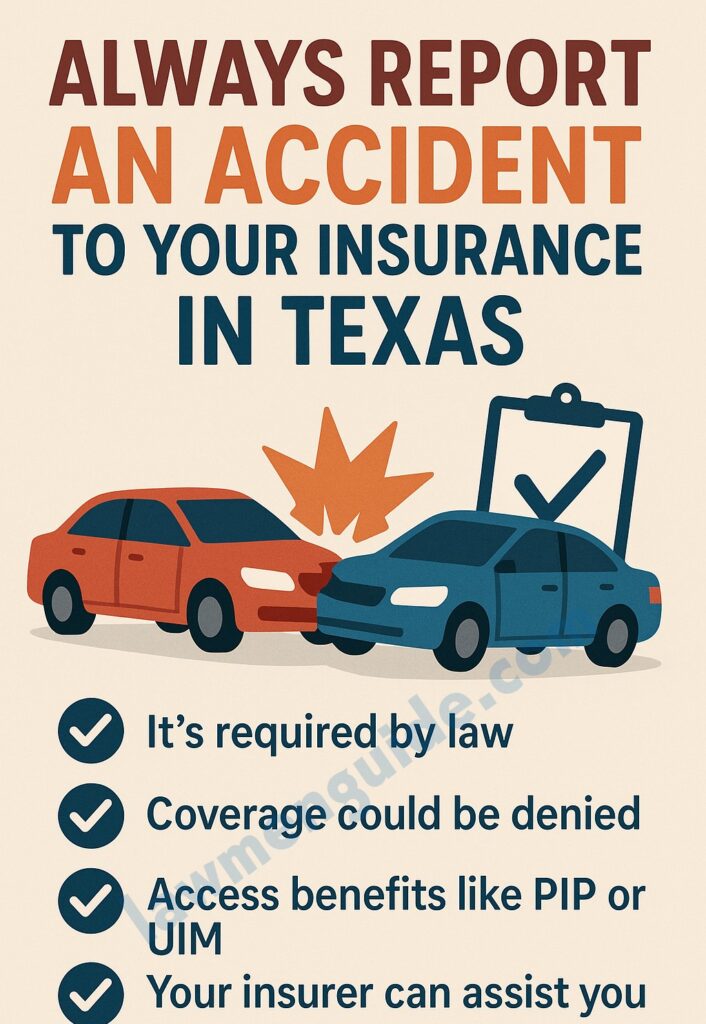
Insurance companies require prompt reporting so they can properly investigate, defend, and pay claims. Even if you are not at fault, failing to report could allow your insurer to deny coverage if the situation escalates, or if the other driver later blames you for damages or injuries.
2. Protecting Yourself From Liability
You may feel confident you weren’t at fault, but the other party may later change their story, or additional damages may become apparent after the fact. By notifying your insurer, you protect yourself from future disputes and allow your company to defend you if you’re sued.
3. Access to Your Own Policy Benefits
If the at-fault driver’s insurance is slow to pay, or if they are uninsured/underinsured, you may need to access your own policy benefits such as:
- Collision coverage: Pays for your vehicle repairs, regardless of fault.
- Uninsured/Underinsured Motorist (UM/UIM) coverage: Protects you if the other driver lacks adequate insurance.
- Medical payments (MedPay) or Personal Injury Protection (PIP): Covers medical expenses for you and your passengers.
You can’t use these coverages unless you’ve reported the accident to your insurer promptly.
4. Subrogation and Deductible Reimbursement
If you use your own collision coverage, your insurance company can seek reimbursement from the at-fault driver’s insurer (subrogation). If they recover the costs, you often get your deductible back.
5. Documentation for Future Issues
Reporting the accident creates an official record. If the other party later claims new injuries or damages, your insurer is better positioned to handle the claim—and you have proof that you acted responsibly.
What Happens If You Don’t Report the Accident?
Failing to report a car accident—even if it seems minor or you believe you were not at fault—can have a range of negative consequences in Texas. Many drivers think that if there’s no immediate damage or the other party seems cooperative, they can simply walk away without notifying their insurance company. However, this is a risky approach with serious potential downsides.
1. Denied Insurance Claims
One of the most common outcomes of failing to report an accident is that your insurance company may deny your claim. Most insurance policies in Texas require you to report any accident, regardless of fault, within a reasonable time frame. If you attempt to file a claim days or weeks later—perhaps because you discovered hidden damage or the other party changed their story—your insurer might refuse to cover your repairs or medical expenses. The lack of a timely report can be used as a reason to deny payment.
2. Loss of Coverage Benefits
Your auto insurance policy likely includes valuable protections such as collision coverage, medical payments, and uninsured/underinsured motorist coverage. If you don’t report the accident promptly, you may lose the ability to use these benefits, leaving you to pay out of pocket for damages or injuries that should have been covered.
3. Increased Legal Risks
In Texas, drivers are required by law to report certain types of accidents—those involving injuries, fatalities, or significant property damage—to law enforcement. Failing to do so could lead to legal trouble, including fines, penalties, or even license suspension. Even if the accident was minor, if the other party later claims an injury or significant loss, you could face lawsuits without any support from your insurance provider.
4. Difficulty Proving Your Case
When accidents aren’t reported, it becomes much harder to establish the facts if a dispute arises later. If the other driver claims you were at fault, or files a lawsuit, you won’t have an official record or your insurer’s backing to help defend your interests. This lack of documentation can lead to unfavorable outcomes, such as having to pay damages you didn’t cause.
5. Out-of-Pocket Expenses
If you don’t report an accident and problems develop later, you may have to pay for repairs, medical bills, or legal costs entirely out of your own pocket. The cost of fixing even a seemingly small issue—like a bumper or fender—can quickly escalate, especially if additional damage is discovered later.
6. Policy Cancellation or Non-Renewal
Repeated failure to report accidents, or being involved in an incident that later escalates into a dispute, can put your insurance policy at risk. Some companies may decide to cancel your policy or refuse to renew it if they believe you have not been forthcoming or have violated the terms of your contract.
Why Timely Reporting Is Always the Best Policy
It can be tempting to avoid reporting a minor accident—especially if you fear your premiums might rise or you want to keep things simple. However, in the long run, reporting is almost always the best option. Not only does it protect your legal rights and your financial security, but it also demonstrates to both your insurer and the law that you are a responsible driver.
Insurance companies are not just there to pay claims; they also provide legal defense, investigate disputed accidents, and negotiate with other parties on your behalf. Prompt reporting gives them the information and time they need to do their job—and gives you peace of mind knowing that you’re protected, no matter how the situation evolves.
Next Steps:
If you’ve been involved in an accident in Texas, make reporting a priority—even if it wasn’t your fault. Contact your insurance company as soon as possible, provide accurate details, and keep records of your communications. If you’re ever in doubt about your obligations, review your policy or speak with a qualified attorney or insurance professional for advice tailored to your situation.
Real-World Scenarios: Why Reporting Matters
Scenario 1: The Other Driver Changes Their Story
Imagine you were rear-ended at a stoplight. At the scene, the other driver admits fault and offers to pay for your repairs directly, asking you not to report the accident to insurance. A week later, you receive a letter from their insurance company denying responsibility and suggesting you were backing up. Without a timely report to your own insurance, you’re left with little support or documentation to prove your case. If you had reported promptly, your insurer would have been better positioned to defend you or negotiate a fair settlement.
Scenario 2: Delayed Injury Symptoms
Some injuries, such as whiplash or mild concussions, don’t show symptoms immediately. If you don’t report the accident to your insurer and develop symptoms days later, you may have difficulty getting your medical bills covered—especially if the at-fault driver becomes uncooperative. Early reporting ensures your insurer is aware of the event and can support you if health complications arise.
Scenario 3: Uninsured or Underinsured Drivers
Texas has a relatively high rate of uninsured drivers. If the at-fault party has insufficient or no insurance, you’ll need to tap into your uninsured/underinsured motorist (UM/UIM) coverage. This can only be activated if you report the accident promptly. Waiting too long, or failing to report at all, can result in a denied claim, leaving you to pay for damages out of pocket.
Legal Insights: The Importance of Compliance
Policy Language Matters
Insurance policies in Texas almost universally contain a “notice of claim” requirement. This means you must inform your insurer about an accident within a reasonable time—even if you’re not making a claim. Some policies specify 24-48 hours, while others simply say “promptly.” Failing to comply gives your insurer legal grounds to deny coverage or limit their liability.
State Law Requirements
- Texas Transportation Code §550.026: Requires drivers to report accidents involving injury, death, or property damage exceeding $1,000 to law enforcement immediately.
- Texas Insurance Code: Mandates that drivers carry minimum liability insurance, and encourages drivers to inform their insurance company after any accident for proper claims handling.
Potential Pitfalls of Not Reporting
- Disputes over fault: If the facts of the accident are later questioned, you may be left without critical documentation.
- Claim denials: Both your and the other driver’s insurance may refuse payment for damages if reporting procedures were not followed.
- Out-of-pocket expenses: If your claim is denied, you may have to pay for repairs and medical care yourself.
- Legal consequences: Failing to report a qualifying accident can lead to tickets, fines, or even criminal penalties in serious cases.
Additional FAQs
Does reporting an accident go on my driving record in Texas?
Only accidents reported to law enforcement or resulting in insurance claims that are ultimately settled as your fault will appear on your driving record. Simply notifying your insurer of a not-at-fault accident typically does not affect your record.
What information should I provide to my insurance company?
Be factual and concise. Provide the date, time, location, a description of what happened, the other driver’s details, and photos if available. Avoid speculating about fault or admitting blame.
Can I choose any repair shop after an accident?
Texas law allows you to select your own repair shop, though your insurer may have recommendations or require estimates from approved providers.
What if I discover additional damage later?
If you’ve already reported the accident, you can submit supplemental claims for new damage found during repairs. If you didn’t report initially, your insurer may deny additional claims.
Expert Tips for Texas Drivers
- Always document the scene: Take clear photos of all vehicles, license plates, damage, and the surrounding area.
- Never accept cash at the scene: While it may be tempting, undocumented settlements can lead to future disputes or denied claims.
- Keep a copy of your insurance card and policy in your vehicle: This makes reporting easier in stressful situations.
- Be aware of “comparative fault” rules: In Texas, your compensation may be reduced if you are partially at fault, but prompt reporting and documentation can help establish the facts.
- Consult an attorney if injuries are involved: Serious accidents or contested claims can benefit from legal guidance.
Final Thoughts
Texas is a “fault” state when it comes to auto accidents, but insurance companies and state laws both strongly encourage—if not outright require—you to report every accident, regardless of fault. This is about more than protecting yourself financially; it’s about ensuring your legal rights and avoiding unnecessary risk.
When in doubt, always err on the side of caution and contact your insurance provider. Timely and accurate reporting ensures you’re covered, minimizes disputes, and can even help recover your deductible in not-at-fault cases.
Quick Reference Table
| Situation | Must Report to Insurance? | Must Report to Police? |
|---|---|---|
| Minor accident, no injuries, low damage | Yes (policy requirement) | Not always (if damage <$1,000) |
| Accident with injuries or death | Yes | Yes (immediately) |
| Damage >$1,000 | Yes | Yes |
| Uninsured/Underinsured driver involved | Yes (to use UM/UIM) | Police recommended |
| Not your fault, no claim anticipated | Yes (protect yourself) | No, unless above apply |
Need More Guidance?
If you’re unsure what your policy requires, check your policy documents or call your agent for specifics. If you’ve been in an accident and need help navigating the claims process or dealing with insurance adjusters, consider consulting a Texas car accident attorney to ensure your rights are protected.
- Sierra Mist Lawsuit : What’s Actually True And What’s Internet Rumor

- Ashcroft Capital Lawsuit: Investor Concerns and Legal Challenges Explained

- Edward jones kingsview advisors lawsuit: Everything You Need to Know

- Denver Restaurant Service Charge Lawsuit: A Comprehensive Guide to Dining Fees and Worker Rights

- Texas Renaissance Festival Lawsuit: What the $60M Forced Sale Means

- Capitol Plaque Lawsuit: Why Officers Are Suing Even After Installation