
In the realm of personal injury law, establishing liability hinges on proving that the defendant’s actions were not only the actual cause but also the proximate cause of the plaintiff’s injuries. While actual cause refers to the direct cause-and-effect relationship, proximate cause delves into whether the harm was a foreseeable consequence of the defendant’s conduct. This article explores the concept of proximate cause through real-world examples, legal precedents, and its application in various personal injury scenarios.
What Is Proximate Cause?
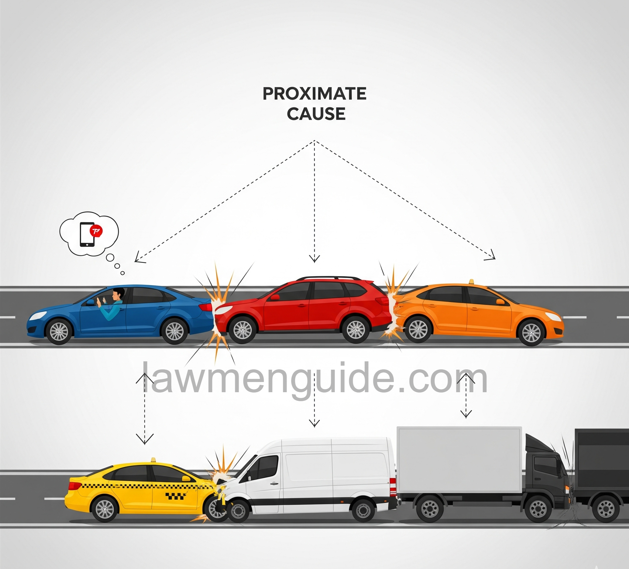
Proximate cause, often termed “legal cause,” is a legal concept that limits liability to consequences that bear a reasonable relationship to the defendant’s conduct. It serves to prevent defendants from being held liable for every consequence of their actions, especially those that are unforeseeable or too remote.
Key Elements of Proximate Cause:
- Foreseeability: The harm must be a foreseeable result of the defendant’s actions.
- Direct Causation: There should be a direct link between the conduct and the injury, without significant intervening causes.
- Natural and Probable Consequence: The injury must be a natural and probable outcome of the defendant’s actions.
Real-World Examples of Proximate Cause
1. Distracted Driving Leading to a Multi-Car Pileup
A driver texting while driving rear-ends another vehicle, causing a chain reaction involving multiple cars. The initial act of distracted driving is the proximate cause of the subsequent accidents, as the collisions are a foreseeable result of not paying attention to the road.
2. Negligent Maintenance Resulting in Injury
A property owner fails to repair a broken stair railing. A visitor leans on it, falls, and sustains injuries. The property owner’s negligence in maintaining the railing is the proximate cause of the visitor’s injuries, as such an accident is a foreseeable consequence of the neglect.
3. Medical Malpractice Leading to Complications
A surgeon leaves a surgical instrument inside a patient, leading to infection and further complications. The surgeon’s negligence is the proximate cause of the patient’s additional health issues, as such outcomes are foreseeable in cases of surgical errors.
4. Defective Product Causing Harm
A manufacturer produces a faulty electric kettle that overheats and causes burns to a user. The manufacturer’s failure to ensure product safety is the proximate cause of the user’s injuries, as harm from defective appliances is a foreseeable risk.
5. Inadequate Security Leading to Assault
A hotel neglects to provide adequate lighting and security in its parking lot. A guest is assaulted in the poorly lit area. The hotel’s failure to maintain safe premises is the proximate cause of the assault, as such incidents are foreseeable in unsecured environments.
Legal Precedents Illustrating Proximate Cause
Palsgraf v. Long Island Railroad Co. (1928)
In this landmark case, a man boarding a train dropped a package containing fireworks, which exploded and caused a scale to fall, injuring Helen Palsgraf. The court held that the railroad was not liable, as the injury was not a foreseeable result of the employees’ actions. This case established the importance of foreseeability in determining proximate cause.
Wagon Mound (No. 1) (1961)
In this case, oil spilled from a ship caught fire and damaged a wharf. The court ruled that the shipowners were not liable, as the fire damage was not a foreseeable consequence of the oil spill. This case reinforced the principle that liability is limited to foreseeable damages.
Application of Proximate Cause in Various Personal Injury Scenarios
Car Accidents
In car accident cases, establishing proximate cause involves demonstrating that the defendant’s negligent driving directly led to the plaintiff’s injuries. For instance, if a driver runs a red light and hits another vehicle, causing injuries, the driver’s actions are the proximate cause of the harm.
Slip and Fall Incidents
Property owners have a duty to maintain safe premises. If a customer slips on a wet floor in a store without warning signs and sustains injuries, the store’s negligence is the proximate cause of the accident.
Medical Malpractice
In medical malpractice cases, proximate cause is established by showing that the healthcare provider’s deviation from the standard of care directly resulted in the patient’s injury. For example, administering the wrong medication leading to adverse effects constitutes proximate cause.
Product Liability
Manufacturers are liable for injuries caused by defective products if the harm was a foreseeable result of the defect. For instance, a malfunctioning airbag that fails to deploy during an accident, causing injuries, is a case where the manufacturer’s negligence is the proximate cause.
Premises Liability
Property owners must ensure their premises are safe for visitors. If inadequate lighting in a parking lot leads to a visitor being assaulted, the owner’s failure to provide a secure environment is the proximate cause of the injury.
Factors Influencing the Determination of Proximate Cause
- Foreseeability of Harm: Was the injury a foreseeable result of the defendant’s actions?
- Directness of the Cause: Is there a direct link between the conduct and the injury?
- Intervening Causes: Did any independent events occur that could break the chain of causation?
- Policy Considerations: Would holding the defendant liable serve justice and public policy?
Challenges in Proving Proximate Cause
- Complex Causation Chains: In cases with multiple contributing factors, isolating the defendant’s actions as the proximate cause can be challenging.
- Intervening Events: Unforeseen events occurring between the defendant’s action and the injury may complicate the establishment of proximate cause.
- Speculative Damages: Claims involving speculative or indirect damages may face hurdles in proving proximate cause.
Conclusion
Proximate cause is a pivotal concept in personal injury law, serving as a gatekeeper for assigning legal liability. It ensures that defendants are held accountable only for harms that are a foreseeable and direct result of their actions. Understanding and effectively demonstrating proximate cause is essential for the success of personal injury claims.
Frequently Asked Questions (FAQs)
What distinguishes proximate cause from actual cause?
Actual cause refers to the direct cause-and-effect relationship between the defendant’s actions and the injury. Proximate cause, on the other hand, considers whether the injury was a foreseeable consequence of the actions, thereby limiting liability to outcomes closely related to the conduct.
Can there be multiple proximate causes in a personal injury case?
Yes, multiple parties can have actions that are proximate causes of an injury, especially in complex cases involving several contributing factors.
How does foreseeability impact proximate cause?
Foreseeability is central to proximate cause. If the harm was a foreseeable result of the defendant’s actions, it strengthens the argument for proximate cause.
What role do intervening causes play in determining proximate cause?
An intervening cause can break the chain of causation if it is an unforeseeable and independent event, potentially absolving the defendant of liability.
Why is proximate cause important in personal injury lawsuits?
Proximate cause is crucial because it establishes a legal link between the defendant’s conduct and the plaintiff’s injury, determining whether the defendant can be held liable for damages.
- Sierra Mist Lawsuit : What’s Actually True And What’s Internet Rumor

- Ashcroft Capital Lawsuit: Investor Concerns and Legal Challenges Explained

- Edward jones kingsview advisors lawsuit: Everything You Need to Know

- Denver Restaurant Service Charge Lawsuit: A Comprehensive Guide to Dining Fees and Worker Rights

- Texas Renaissance Festival Lawsuit: What the $60M Forced Sale Means

- Capitol Plaque Lawsuit: Why Officers Are Suing Even After Installation