
As dashcams become more common on Texas roads, many people wonder: Can dashcam footage actually help you in a personal injury lawsuit? The short answer is yes—dashcam video can be used in court to support or challenge claims in personal injury cases. However, its admissibility depends on certain legal factors and how the footage is obtained, stored, and presented.
Is Dashcam Footage Admissible in Texas Courts?
Yes, dashcam footage is generally admissible as evidence in Texas civil courts—including personal injury cases—if it meets these conditions:
- Relevance: It must help prove or disprove an important fact in the case (e.g., who was at fault).
- Authenticity: The footage must be verified as genuine (unaltered and time-stamped).
- Legality: It must have been recorded in compliance with Texas privacy and surveillance laws.
Texas follows the “one-party consent” rule, meaning dashcam recordings are legal if at least one person involved in the conversation or recording consents—which is typically the vehicle owner or driver.
How Dashcam Footage Helps in Personal Injury Cases
Dashcam footage can play a critical role in clarifying what really happened before, during, or after an accident. It can:
- Prove liability by showing who caused the crash.
- Support your version of events and contradict false claims.
- Demonstrate vehicle speed, lane usage, and impact angle.
- Capture other factors like traffic signals, weather, and road conditions.
- Provide visual proof of injuries or driver behavior (e.g., distraction or aggression).
This type of evidence is often more persuasive than written statements or verbal testimony.
Situations Where Dashcam Footage Can Be Invaluable
| Scenario | How Dashcam Helps |
|---|---|
| Rear-end collision | Shows braking behavior or distraction |
| Hit-and-run | Captures fleeing vehicle or plate number |
| Disputed liability | Confirms lane changes, signaling, or speeding |
| Pedestrian accidents | Clarifies visibility and crossing behavior |
| Insurance fraud | Detects staged accidents or false injury claims |
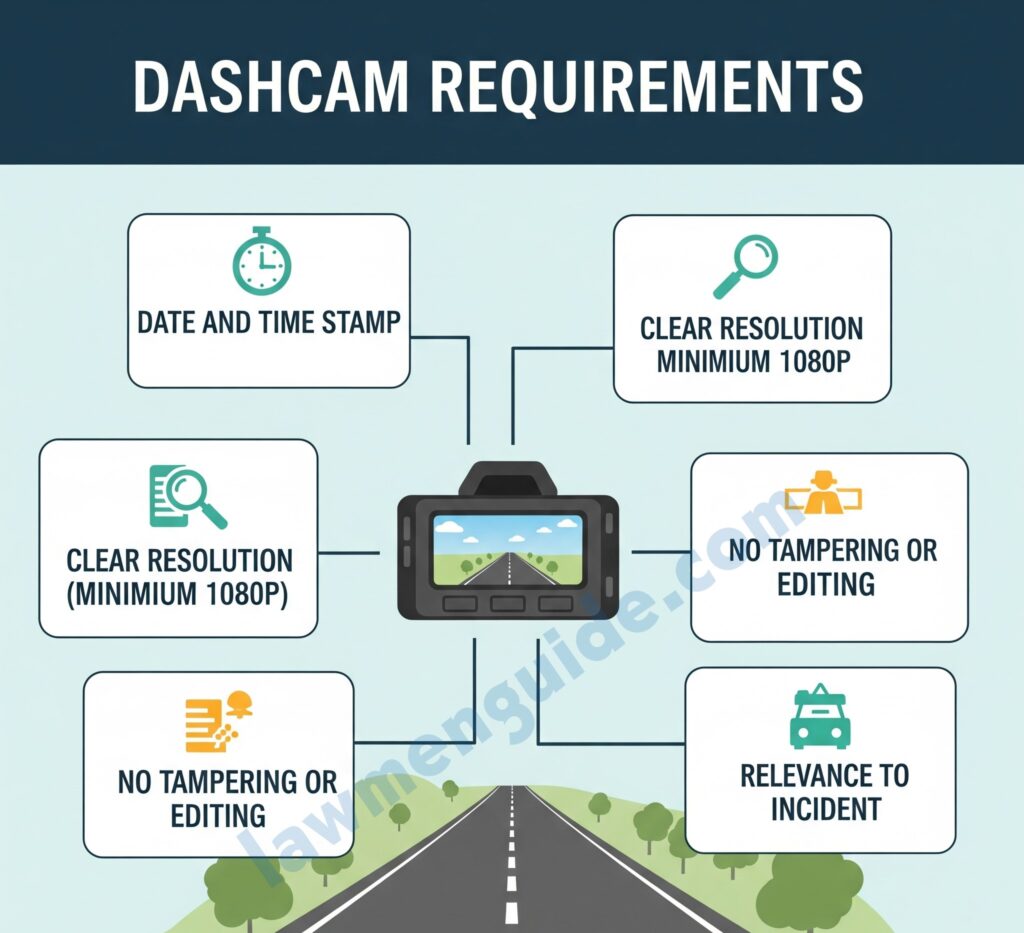
Requirements for Dashcam Footage to Be Accepted
To improve your chances of having dashcam footage accepted in court, it must:
- Be clear and unedited
- Include date and time stamps
- Be stored securely with chain of custody if possible
- Be presented by someone who can verify the footage’s origin (usually the driver or owner)
- Be voluntarily submitted or legally obtained through subpoena or discovery
It’s also important to submit the footage to your attorney as early as possible so it can be reviewed and preserved properly.
Can Dashcam Footage Hurt Your Case?
Yes, if not used carefully. While dashcams can help prove your case, they can also work against you by revealing:
- Your own traffic violations (speeding, texting, running lights)
- Partial fault in a comparative negligence case
- Non-use of seatbelts or safety protocols
Texas uses modified comparative fault rules, meaning if you are found more than 50% at fault, you may be barred from compensation. Even partial liability reduces your recovery amount.
How to Present Dashcam Evidence in Texas Court
- Submit the footage to your attorney immediately after the accident.
- Create backup copies in multiple formats (MP4, AVI, USB, cloud, etc.).
- Log when and how the footage was downloaded to maintain chain of custody.
- Your attorney may:
- Use it during settlement negotiations
- Submit it as evidence in pre-trial motions
- Present it in courtroom playback or expert analysis
Judges and juries often find video evidence highly credible.
FAQs
Is it legal to record passengers in my car without their consent?
In Texas, yes—as long as you are a participant in the conversation, recording audio or video inside your own car is legal.
Can I use dashcam footage from someone else’s vehicle?
Possibly, but it may require their consent or a subpoena, especially if they’re not part of the case.
Do insurance companies accept dashcam evidence?
Yes. Insurers often accept and review dashcam footage when determining liability or processing claims.
What if the footage includes private conversations?
Such content may be excluded if it’s deemed irrelevant or violates privacy laws. Courts may redact sensitive portions.
How long should I keep the dashcam footage?
Until the claim is fully resolved. If a lawsuit is filed, keep it until the final verdict or settlement.
Final Thoughts
Dashcam footage can be a powerful tool in Texas personal injury cases—if it’s relevant, properly stored, and legally obtained. Whether it supports your version of events or exposes the truth in a disputed crash, it often makes the difference between a weak claim and a strong one.
If you’ve been involved in an accident and have dashcam footage, consult with a personal injury attorney immediately. They can assess its usefulness, prepare it for court, and use it to help maximize your compensation.
- Sierra Mist Lawsuit : What’s Actually True And What’s Internet Rumor

- Ashcroft Capital Lawsuit: Investor Concerns and Legal Challenges Explained

- Edward jones kingsview advisors lawsuit: Everything You Need to Know

- Denver Restaurant Service Charge Lawsuit: A Comprehensive Guide to Dining Fees and Worker Rights

- Texas Renaissance Festival Lawsuit: What the $60M Forced Sale Means

- Capitol Plaque Lawsuit: Why Officers Are Suing Even After Installation