
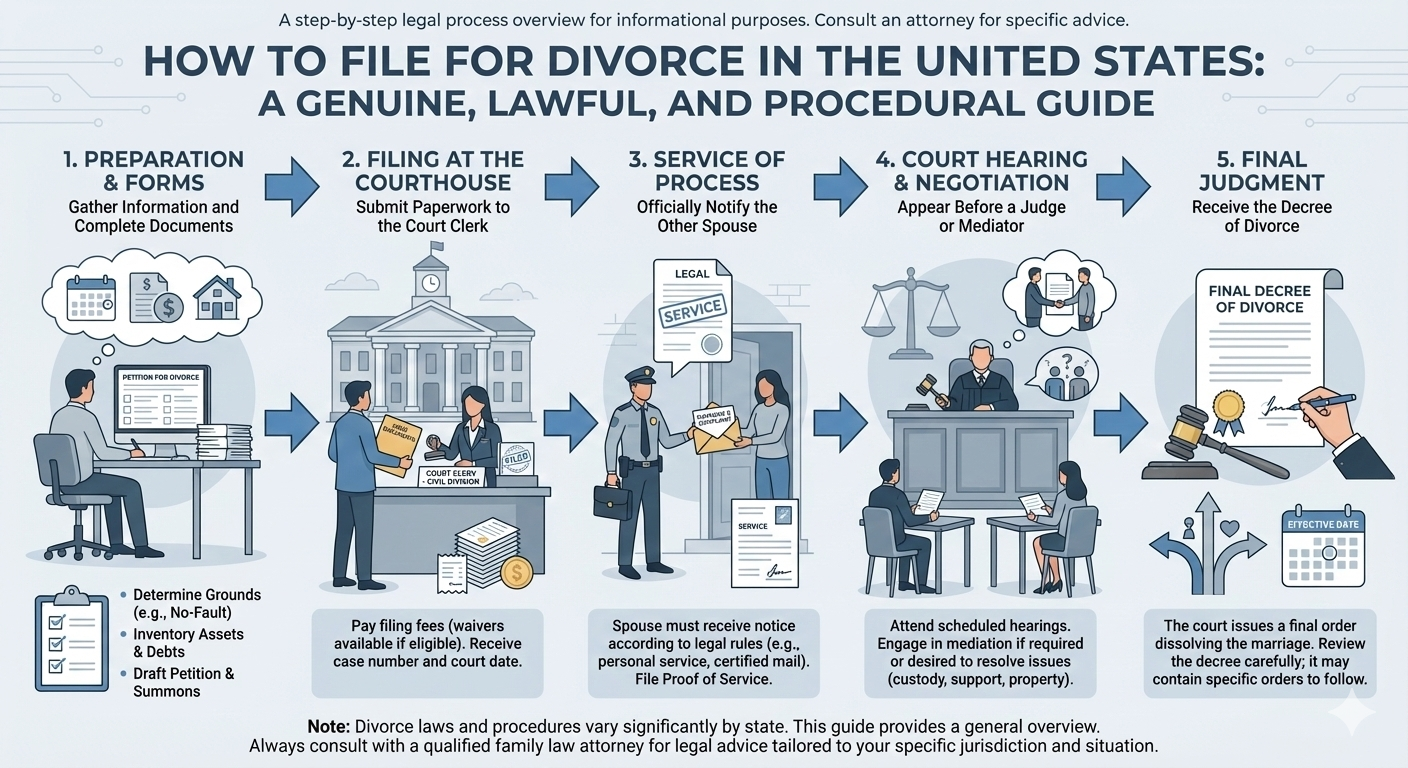
Divorce is a legal process governed by state law in the United States. While personal circumstances vary widely, the legal framework for filing and completing a divorce follows established procedures designed to ensure fairness, due process, and enforceability. This article provides a clear, factual overview of how to file for divorce in the United States using only lawful and verifiable steps. It avoids assumptions regarding fault, intent, or emotional circumstances and focuses exclusively on recognized legal procedure and best practices.
Because divorce law is determined at the state level, specific requirements differ by jurisdiction. This article addresses general principles common to most U.S. states and emphasizes the importance of consulting a licensed attorney for state-specific guidance.
1. Understanding Jurisdiction and Residency Requirements
Before a divorce can be filed, the court must have legal authority known as jurisdiction over the case. Jurisdiction typically depends on residency.
Most states require that at least one spouse has lived in the state for a minimum period before filing. Residency requirements commonly range from three months to one year, depending on the state. Some states also impose a county-level residency requirement.
Key points:
- Filing in the wrong jurisdiction can result in dismissal.
- Proof of residency may be required.
- Military members and spouses may have special rules.
Determining proper jurisdiction is the first lawful step in the divorce process.
2. Grounds for Divorce: Fault and No-Fault Systems
U.S. states generally recognize either no-fault divorce, fault-based divorce, or both.
No-Fault Divorce
In a no-fault divorce, neither spouse is required to prove wrongdoing. Common no-fault grounds include:
- Irreconcilable differences
- Irretrievable breakdown of the marriage
- Incompatibility
Fault-Based Divorce
Some states still permit fault-based grounds, such as adultery, abandonment, cruelty, or substance abuse. Choosing fault-based grounds may affect procedure, evidence requirements, and timelines.
Importantly, selecting grounds is a legal decision, not an emotional one. In many cases, no-fault filing simplifies the process and reduces litigation.
3. Preparing and Filing the Divorce Petition
The divorce process formally begins when one spouse (the petitioner) files a legal document with the court. This document is often called:
- Petition for Divorce
- Complaint for Divorce
- Petition for Dissolution of Marriage
The petition typically includes:
- Names of both spouses
- Date and place of marriage
- Confirmation of residency
- Grounds for divorce
- Requests regarding property, debts, custody, support, or other legal issues
Accuracy is critical. False or incomplete information can delay proceedings or create legal exposure.
Once prepared, the petition is filed with the appropriate court and accompanied by a filing fee, which varies by state and county. Fee waivers may be available based on income.
4. Service of Process: Legal Notice to the Other Spouse
After filing, the petitioner must legally notify the other spouse (the respondent). This step is known as service of process and is required to satisfy due process rights.
Service methods vary by state and may include:
- Personal service by a process server or sheriff
- Certified mail
- Acceptance or waiver of service
- Publication (in limited circumstances)
Informal notice is not sufficient. Proper service ensures the court has authority to proceed and protects the enforceability of future orders.
5. Response and Initial Court Deadlines
Once served, the respondent has a legally defined period often 20 to 30 days to file a response.
The response may:
- Agree with the petition
- Disagree with some or all requests
- Include counterclaims
Failure to respond can result in a default judgment, allowing the court to proceed without the respondent’s input.
At this stage, courts may also schedule initial conferences or require preliminary disclosures.
6. Financial Disclosures and Transparency Requirements
Most states require both parties to provide detailed financial disclosures early in the divorce process. These disclosures promote transparency and equitable resolution.
Disclosures often include:
- Income statements
- Tax returns
- Bank and investment accounts
- Real estate holdings
- Retirement accounts
- Debts and liabilities
- Business interests
Providing complete and truthful financial information is a legal obligation. Concealment or misrepresentation can result in sanctions, reopened judgments, or adverse rulings.
7. Temporary Orders During the Divorce Process
Because divorce proceedings can take months or longer, courts often issue temporary orders to address immediate issues.
Temporary orders may cover:
- Child custody and parenting time
- Child support
- Spousal support
- Use of marital property
- Payment of household expenses
These orders are not final but remain in effect until replaced by agreement or final judgment.
8. Negotiation, Mediation, and Settlement Efforts
Most U.S. courts encourage or require parties to attempt resolution before trial. This may involve:
- Informal negotiation between attorneys
- Mediation with a neutral third party
- Settlement conferences
Settlement agreements typically address:
- Division of marital property and debts
- Child custody and parenting plans
- Child support
- Spousal support
Agreements must comply with state law and are subject to court approval. A properly drafted settlement can significantly reduce cost, time, and uncertainty.
9. Property Division Principles
States follow one of two primary systems for dividing marital property:
Equitable Distribution States
Most states divide property based on fairness, not necessarily equal division. Courts consider factors such as:
- Length of marriage
- Contributions of each spouse
- Economic circumstances
Community Property States
A smaller number of states treat most marital property as jointly owned and divide it equally.
Separate property such as assets acquired before marriage or by inheritance may be excluded during divorce asset valuations, depending on state law and factual circumstances.
10. Child Custody and Support Considerations
When children are involved, courts prioritize the best interests of the child. Decisions are guided by statutory factors, not parental preference.
Custody determinations may include:
- Legal custody (decision-making authority)
- Physical custody (residence and time-sharing)
Child support is generally calculated using statutory guidelines based on income and parenting time. Courts require compliance with these guidelines unless deviation is legally justified.
11. Court Hearings and Trial (If Necessary)
If parties cannot reach agreement, the case proceeds to hearings or trial. At trial:
- Evidence is presented
- Witnesses may testify
- Legal arguments are made
The judge then issues rulings on unresolved issues. Trials increase time, cost, and uncertainty, which is why settlement is often encouraged.
12. Final Judgment of Divorce
A divorce is not legally complete until the court issues a final judgment or decree of divorce. This document:
- Terminates the marriage
- Sets forth all final orders
- Is legally enforceable
Some states impose waiting periods before finalization, even in uncontested cases. Compliance with all procedural steps is required before the court will issue the final decree.
13. Post-Divorce Legal Considerations
After divorce, parties may need to:
- Transfer property titles
- Update estate planning documents
- Modify support orders (if legally justified)
- Enforce or comply with court orders
Failure to follow post-divorce obligations can result in enforcement actions.
Conclusion
Filing for divorce in the United States is a structured legal process governed by state law and judicial procedure. While individual circumstances differ, the lawful steps jurisdiction, filing, service, disclosure, negotiation, and final judgment are consistent in principle across jurisdictions.
This process is not based on assumptions, emotional narratives, or informal arrangements. It relies on verified procedures, documented disclosures, and court oversight to ensure legality and enforceability.
Because divorce laws vary by state and individual facts can significantly affect outcomes, consulting a licensed attorney or qualified legal consultant is strongly recommended. Professional guidance ensures compliance with current law and protects legal rights throughout the process.