
If your car has been towed and impounded by police in Texas, you’re probably already stressed—and the last thing you want is surprise charges when you try to recover your vehicle. One of the biggest concerns Texas vehicle owners have is: Can tow companies charge storage fees after a police impound? The answer is yes, but state law strictly regulates what fees can be charged, how much, and for how long.
Here you know, what fees are legal, how storage charges are calculated, your rights, and what steps to take if you believe you’ve been overcharged—using the most up-to-date Texas laws and 2024 fee limits.
Understanding Police Impounds and Storage Fees in Texas
When law enforcement impounds your car—whether for illegal parking, an accident, abandonment, evidence, or another reason—the vehicle is typically taken to a licensed Vehicle Storage Facility (VSF). Once your car enters a VSF, you, as the owner, are usually responsible for certain fees before the vehicle can be released.
Legal Framework
- Texas Occupations Code, Chapters 2303 and 2308
- Texas Administrative Code, Chapter 85
- Oversight: Texas Department of Licensing & Regulation (TDLR)
These regulations define exactly what tow and storage companies can and cannot charge.
What Fees Are Legally Allowed After Police Impound?
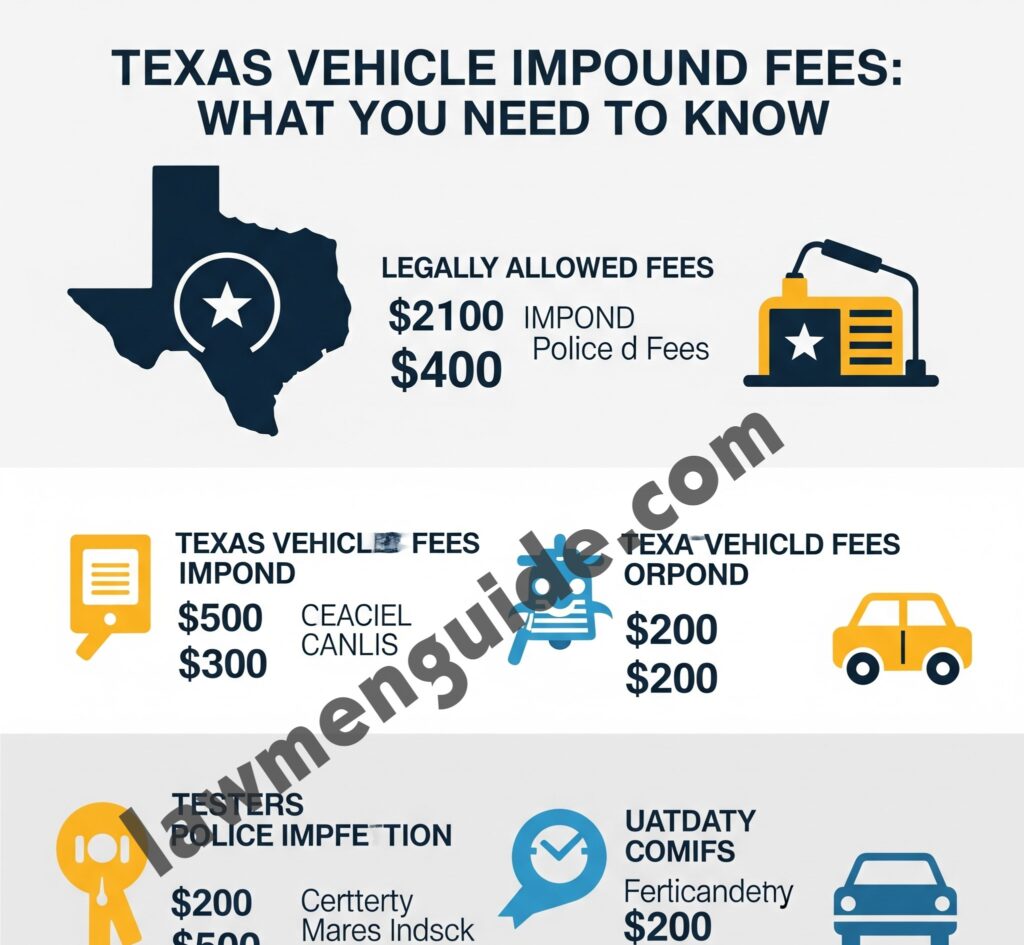
According to Texas law, only four types of fees are allowed after a government-authorized tow (police impound):
| Fee Type | Description | Maximum Allowed (2024) |
|---|---|---|
| Notification Fee | For sending a certified letter to the owner/lienholder | $50 flat per notice |
| Impoundment Fee | For basic services like inventory or securing damaged vehicle parts | $20 maximum |
| Daily Storage Fee | For each calendar day the vehicle remains at the storage facility | $22.85/day (≤25 ft vehicle) |
| $39.99/day (>25 ft vehicle) | ||
| Governmental Fee | To cover city, county, or police administrative costs (if required by law) | As set by local authorities |
No other fees (admin, environmental, “release,” processing, etc.) are allowed by law.
How Are Storage Fees Calculated?
- Storage fees begin the day of impoundment. If your car arrives after hours, you’re generally not charged for that day if you retrieve it within 12 hours.
- Each calendar day counts—even if you pick up your vehicle the next morning, you may still owe for two days.
- Charges cannot exceed the maximum rates set by state law (see table above).
- For vehicles registered in Texas: Storage charges can only be collected for up to five days unless the storage facility has sent you a required written notice. After five days, additional fees may be assessed only after notice is sent.
Example: Storage Fees Breakdown
Suppose your sedan (under 25 ft) was impounded and stored for 4 days. You might owe:
| Charge Type | Amount |
|---|---|
| Notification Fee | $50 |
| Impoundment Fee | $20 |
| Daily Storage (4x) | $91.40 ($22.85 x 4) |
| Total | $161.40 |
If you delayed and it reached 10 days after you received notice, the storage portion would be $228.50 ($22.85 x 10), plus the notification and impoundment fees.
Who Pays Storage Fees After Police Impound?
- You (the vehicle owner) usually pay the fees—unless the impound was for police evidence. If law enforcement keeps your car for an investigation, they must cover storage/tow fees until the vehicle is released for pickup. After that, you’re responsible for ongoing storage costs.
- If your car was towed for parking, abandonment, or other non-criminal reasons, you’re responsible for all legal fees upon release.
Your Rights: Contesting or Reducing Fees
You have rights under Texas law:
- Tow Hearing: You can request a hearing (within 14 days) before a Justice of the Peace to challenge the legality of the tow and the amount of fees.
- Fee Disputes: If you’re overcharged (e.g., for prohibited fees or rates above the legal maximum), the hearing officer can reduce or eliminate those charges.
- TDLR Complaints: If you suspect illegal fees or improper procedures, you can file a complaint with the Texas Department of Licensing & Regulation (TDLR).
Common Illegal or Excessive Fees to Watch For
Many Texans report being billed for:
- “Administrative” or “processing” fees
- “Environmental” surcharges
- After-hours access fees
- Additional “release” or “gate” fees
All of these are prohibited by Texas law for police-authorized impounds. If you see them on your bill, challenge them immediately.
Key Points: Notification & Time Limits
| Vehicle Registration | Time Limit Before Notice Required | When Additional Storage Can Be Charged |
|---|---|---|
| Texas-registered vehicle | 5 days | Only after required notice is sent |
| Out-of-state vehicle | 5 days | After attempt to get registration info & notice sent |
If the facility doesn’t send the proper notification, they cannot legally continue charging you daily storage beyond the time limit.
Data Table: Texas Maximum Towing & Storage Fees (2025)
| Fee Type | Amount/Limit | Applies To |
|---|---|---|
| Notification Fee | $50 | Each required notice (certified mail) |
| Impoundment Fee | $20 | One-time per vehicle |
| Daily Storage (≤25 ft) | $22.85 | Per day (or part of a day) |
| Daily Storage (>25 ft) | $39.99 | Per day (or part of a day) |
| Governmental/LEO Fee | Local rates vary | If required by local agency |
(Source: Texas Department of Licensing & Regulation, 2024 fee schedule)
Frequently Asked Questions (FAQ)
Q: What if I can’t afford the storage fees?
A: If your car is not picked up and fees exceed its value, the VSF may eventually auction the vehicle to cover costs. You can still request a hearing to dispute improper fees.
Q: How quickly should I pick up my car after impound?
A: As soon as possible. Storage fees add up daily, and after the legal notice period, the costs can escalate quickly.
Q: Are storage facilities required to accept credit/debit cards?
A: Yes. By Texas law, VSFs must accept credit/debit cards, cash, and checks.
Q: Can the police waive my fees?
A: Generally, only if your car was held specifically for evidence or an investigation; otherwise, you are responsible.
.
Conclusion
Texas tow companies are allowed to charge storage fees after a police impound—but only within strict legal guidelines, and only for the fees listed above. Knowing your rights can save you hundreds of dollars in improper charges. Always request an itemized bill, act quickly to pick up your vehicle, and don’t hesitate to dispute fees that exceed state-mandated limits.
- Sierra Mist Lawsuit : What’s Actually True And What’s Internet Rumor

- Ashcroft Capital Lawsuit: Investor Concerns and Legal Challenges Explained

- Edward jones kingsview advisors lawsuit: Everything You Need to Know

- Denver Restaurant Service Charge Lawsuit: A Comprehensive Guide to Dining Fees and Worker Rights

- Texas Renaissance Festival Lawsuit: What the $60M Forced Sale Means

- Capitol Plaque Lawsuit: Why Officers Are Suing Even After Installation